

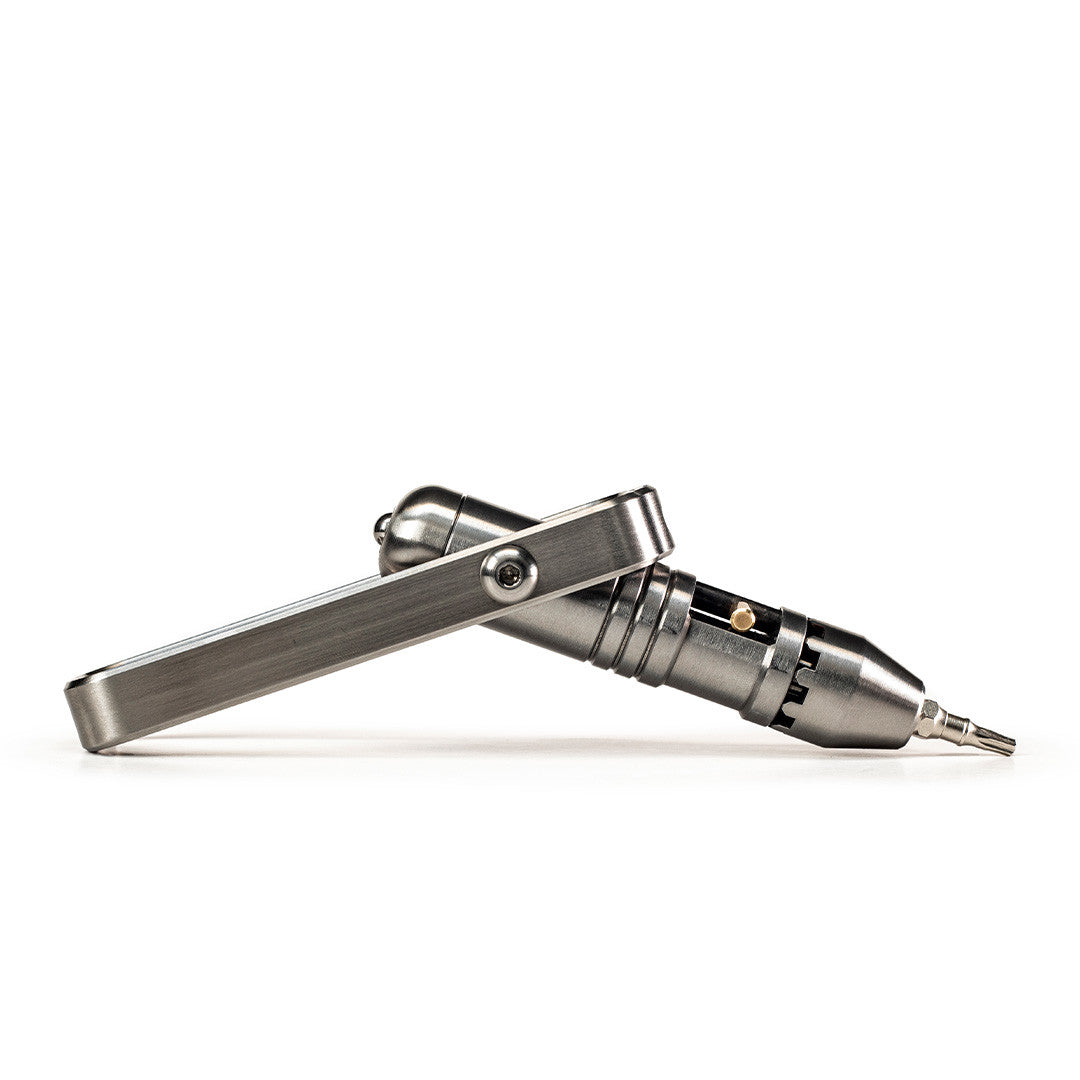
Of all the metals that could make tools and fidget toys, titanium is probably the most MetMo. If you’ve worked with metals, holding titanium instantly feels different. It’s cooler, lighter and generally has a wonderful smell about it. And it’s used in a lot of specialist applications. But, for reasons you’re about to see, titanium isn’t the easiest to work with.
Today, we’re going to look at titanium in more detail, and see what makes it so much of a bruiser.
What is titanium?
Titanium is a white-silvery coloured transition metal with atomic number 22. I know that sounds a bit chemistry-class, but don’t worry – all it means is that it sits in the part of the periodic table associated with metals that can form strong, useful alloys and perform reliably under stress and heat.

And whilst we’re on the topic of chemistry, let me share titanium’s chemical properties. These explain why, what I’m about to explain, doesn’t need explaining.
● Atomic number: 22
● Atomic mass: 47.90 g.mol-1
● Density: 4.51 g.cm-3
● Melting point: 1660 ºC
● Boiling point: 3287 ºC
● Coefficient of thermal expansion: ~8.6 x 10⁻⁸ K-1
It’s best known for its four standout traits:
● Its strength-to-weight ratio (the highest of all pure metals)
● Its corrosion resistance
● Its heat resistance
● And its biocompatibility
Titanium is not as rare as its price makes out – it’s actually one of the more abundant elements in the Earth’s crust.
But it’s rarely found as a pure metal.
Titanium loves bonding with oxygen, forming an oxide layer that gives it its corrosion resistance, and also nitrogen and carbon forming titanium nitride and carbide respectively. But because of oxygen’s availability, titanium is almost always found as Rutile (TiO2) and Ilmenite (FeTiO3).
A brief history of titanium
Titanium was discovered in Cornwall back in 1791, by a reverend called William Gregor. He was a clergyman and amateur geologist and spotted what would be named Ilmenite by riverbeds when studying black sand in the Manaccan Valley.
After inspection, he found this mineral contained iron, was magnetic and had an element previously undiscovered inside it. He named it “Menachine” after the valley he was noodling about in.
But when he shared these findings, most didn’t believe him – and so his findings lay dormant, until…
A few years later, a famous German chemist, Martin Heinrich Klaproth, discovered Rutile. He, too, realised there was an unknown element inside. And decided to name it Titanium after the titans of Greek mythology.
And because of his credibility, his findings (and name) were widely accepted. Klaproth kindly admitted he had found the same element as Gregor – so Gregor was given the discovery under Klaproth’s element name.
A tight grip
It was more than a century later until titanium was first isolated. Neither Gregor or Klaproth has been able to separate its grips from oxygen.
Matthew Hunter was the first to develop a process that separated the elements. And his process was rather explosive… He had to test these reactions in a pressure cooker on a university American football field (the Rensselaer Polytechnic Institute, Troy, New York).

Not like this
In the 1940s, William Kroll developed the process further and made it far more feasible for industrial use. So, in the 50s titanium was first used in aerospace. And the Kroll Process has continued to drive our titanium use since.
Side note: While the big shiny metal pieces of titanium are what come to mind when you hear its name… the majority of mined titanium is processed into powdered titanium dioxide (TiO2). This is a bright white pigment used in lots of everyday products like paint, paper, toothpaste and suncream.
Titanium’s properties
We know its chemistry, and how it came to be. Now let’s look at its properties in more detail.
Grade expectations: Titanium’s strength
Titanium is often described as being “as strong as steel but lighter”. And that’s broadly the right idea… but with an important nuance.
Titanium isn’t always the strongest metal in absolute terms. But it is one of the best metals at delivering strength per unit mass. This is why you see titanium in aerospace, and other weight-penalised systems where every gram saved means fuel savings, speed and efficiency improvements, reduced fatigue over time and a friendly pat on the back.
Of course, strength varies by grade.
Commercially pure titanium (Grades 1-4) are generally more ductile, corrosion-focused and ‘moderate’ strength. Grade 5 titanium (Ti-6Al-4V) is the common workhorse alloy, boasting a much higher tensile and yield strength than pure grades.
Then there’s Grade 7 with better corrosion resistance, Grade 9 with even better resistance (it’s used for subsea applications), Grade 11 and 12 too – which have better heat resistance and machinability.
So yes, it’s generally stronger than steel – but not always.
The “spring” factor: Stiffness vs strength
Many folks misinterpret strength – and assume that if something is strong it must be stiff too. This isn’t true.
Because titanium’s Young’s Modulus (stiffness) is lower than steel’s (110-160 GPa vs 200 GPa), this means titanium is comparatively more elastic (i.e., the amount of flex under load). This elasticity is a positive feature in many applications:
- Components can flex and return without permanent deformation
- Certain designs benefit from resilience and controlled “give”
- Fatigue performance can be excellent under repeat loadings
But, at the same time, this ‘springiness’ is why titanium can be difficult to machine accurately. More on this soon.
It’s a keeper: Durability and longevity
Titanium almost instantly forms a thin oxide layer (titanium dioxide) when exposed to oxygen. This layer is stable, strongly bonded to the surface, and capable of re-forming if the surface is scratched (when not in a vacuum, at least). It’s this layer that gives titanium its excellent corrosion resistance.
Our metal in question also has excellent fatigue resistance. You see, in many engineered objects, failure isn’t usually because of one excessive load. It can be, sure. But it’s more often caused by millions of smaller stress cycles.
Titanium’s Young’s Modulus means it can elastically deform without accumulating permanent damage, and its crystal structure and microstructure slow down crack formation and growth.
Titanium alloys, especially Grade 5, do this even better. (Grade 5 has an alpha-beta crystal structure, which forces cracks to change direction repeatedly.)
And then, like us all, titanium alloys also have a fatigue limit. In material terms, this means it can theoretically withstand infinite cycles of load (when under a certain limit). This makes them highly valued in dynamic environments (e.g., vibration, movement, and load cycling) because they’ll last longer.
Steel has a fatigue limit too. But aluminum doesn’t. So, regardless of the stress applied, it will eventually fail.
Keeping its cool: heat and dimensional control
Thanks to its Bond, strong (metallic) Bonds, titanium has a high melting temperature. So, it retains its strength at temperatures many other metals would start to weaken.
Similarly, it has a low coefficient of thermal expansion, meaning it expands and contracts less per degree of temperature change. For context, aluminium expands roughly twice as much as titanium!
Why is titanium so hard to work with?
If you’ve ever tried to machine titanium without much research, you’ve likely faced a few issues.
Heat doesn’t go where you want it to go
Titanium is a relatively poor thermal conductor compared to aluminium. During machining, heat tends to concentrate near the cutting edge rather than dissipating cleanly through the workpiece. That concentrated heat accelerates tool wear and can compromise surface finish if you’re not careful.

Spring-back and work hardening
Titanium can flex away from the cutting tool and spring back, which can create chatter and make tight tolerances harder to maintain. Titanium also has a tendency to work harden if you rub rather than cut – so the surface can harden quickly (and increase tool wear).
Why titanium is chosen for precision engineering
Titanium isn’t cheap. So it can’t be used willy-nilly in random applications. You’ll usually find it in applications that demand precision, reliability and long-term performance that justifies the extra cost and effort. Here’s why:
Dimensional stability
Titanium has a lower coefficient of thermal expansion than aluminium and retains its strength at higher temperatures than most lightweight metals. You could even say it stays Ti-ght to spec… In practice, this means parts expand less when heated and are less likely to drift out of tolerance over time. In systems that experience temperature changes – whether from friction, environment or repeated use – this helps maintain consistent fit and function. Even when the heat is on.
Reliability under repeated motion
Fatigue matters in anything that moves, vibrates or is used repeatedly. Titanium alloys have great fatigue resistance, allowing them to endure many load cycles without cracking or permanently deforming. This makes them well suited to dynamic components, mechanisms and tools designed for long service life – it don’t quit or split!
Predictable behaviour under stress
Titanium combines high yield strength with relatively low stiffness compared to steel. This allows it to flex slightly under load and return to its original shape, rather than deforming permanently. When used within design limits, titanium behaves in a controlled and predictable way.
Biocompatibility
Titanium is also biocompatible and supports osseointegration (meaning bone can bond directly to its surface. This is why it's widely used for medical and dental implants. Its elasticity is also closer to that of human bone than steel, which helps reduce stress shielding – a problem where an overly stiff implant carries too much load and causes the surrounding bone to weaken over time.

Comparing titanium to other metals
We’ve covered its key points and given some comparisons, let’s make it more formal (and easier to read).
Titanium vs steel
Where titanium wins:
- Far better strength-to-weight ratio (lighter for comparable strength)
- Excellent corrosion resistance without coatings
- Strong fatigue resistance in many alloys
Where steel wins:
- Cheaper by a wide margin
- Easier and faster to machine and fabricate
- Stiffer (less deflection under load)
- Often stronger in absolute terms (depending on alloy selection)
If you want a cost-effective structure and weight isn’t critical, steel is hard to beat. If weight, corrosion and long-term performance matter, titanium becomes awfully attractive.
Titanium vs stainless steel
Where titanium wins:
- Much lighter than stainless
- Superior corrosion resistance in aggressive chloride environments
- Biocompatibility and long-term stability for implants
Where stainless steel wins:
- Harder surface in many grades (better scratch/wear resistance in some applications)
- Cheaper and more widely available
- Easier to fabricate
Stainless is a great “default” for corrosion resistance. If you need more, titanium is your solution.
Titanium vs aluminum
Where titanium wins:
- Much higher strength (especially in high-performance alloys)
- Dramatically better heat tolerance
- Superior corrosion resistance in many harsh environments
Where aluminium wins:
- Lighter
- Much easier to and faster to machine
- Lower cost
- Excellent for high-volume manufacturing
Aluminium is the productivity champion. Especially its alloys. Titanium is the performance champion (when you can justify the manufacturing complexity.)
Titanium’s uses
In most cases, titanium is only used when its advantages justify the cost – as we’ve already touched on. Cheaper materials can often do a similar job, but not with the same combination of strength, weight, corrosion-resistance and long-term stability.
When those improvements matter enough, titanium becomes a sensible choice:
For example…
- Aerospace – its strength-to-weight ratio, ability to retain strength at elevated temperatures, and long-term reliability in critical structures and engine components.
- Medical and dental – chosen for its biocompatibility and ability to osseointegrate, allowing bone to directly bond to the metal implants and hardware.
- Marine and industrial – because of titanium’s exceptional resistance to seawater and aggressive chemistry.
- High-performance automotive – titanium is used in components like valves, connecting rods, exhaust systems and suspension springs, where its reduced mass improves efficiency.
But there are some exceptions to that rule…
- Fireworks – in powdered form, titanium reacts readily with oxygen and produces bright white sparks.
- Consumer products – Most mined titanium is processed into titanium dioxide, which is used as pigment in paints, suncreams and whitening toothpastes (due to its ability to reflect visible light)
And would you guess it’s now appearing in some rather beautiful (if I do say so myself) tools and fidget toys…
MetMo Titanium Pocket Driver
Think classic Pocket Driver but with a hard-as-nails makeover. This is, at the time of writing, our latest release. We machined it from aerospace-grade Ti-6Al-4V (Grade 5) titanium, and it’s really damn cool.
Who knew you could have so much strength and utility from something that weighs the same as a handful of grapes. We certainly didn’t!

Learn more about the Titanium Pocket Driver here.
MetMo Titanium Edge
Then, we’ve also made a different kind of tool – compared to our usuals at least. In November, we released the edgiest box cutter ever made. It’s built for speed and built to last.
The body is made from titanium and the blade from hardened steel, so you’ll be able to cut, scrape, pry, mark and chisel to your heart’s content for years on years on years.

Learn more about Titanium Edge here.
Ti-me to conclude
There we have it. It might not be the cheapest option, nor the easiest to manufacture but titanium is a rather impressive metal. And now you know why.
I hope you’ve enjoyed reading this – and I’m curious to know… have you had any machining mishaps with titanium? Head over to our subreddit or CubeClub forum and let us know.
See you in the next one!

Share:
Release The Fractal
Pocket science explained: The best 5 types of EDC tools in 2026