

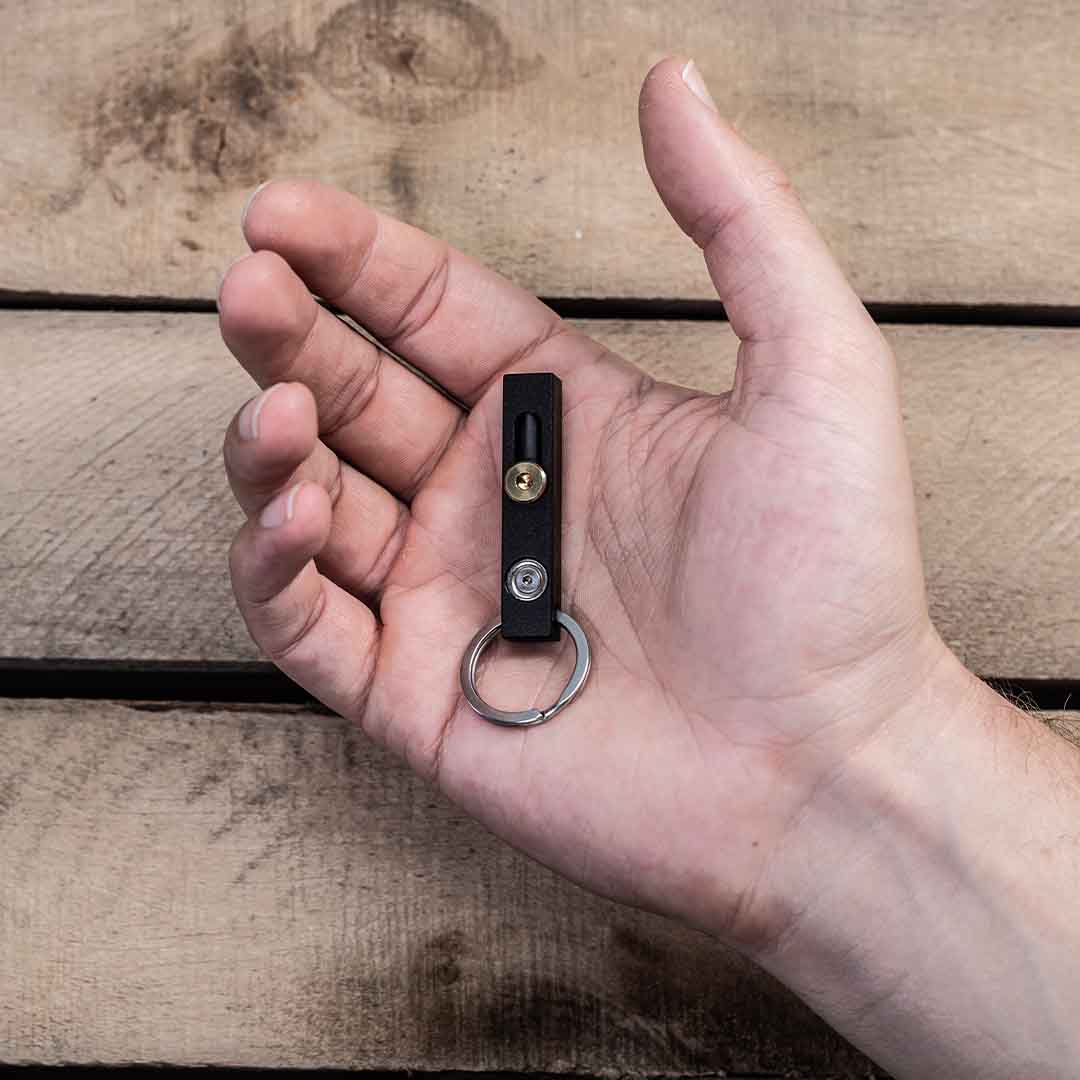
Wanting to own a lot of tools is something I’ll probably never be able to curb. It brings joy on a different level. You might be able to relate. But with EDC, the more you have, the more you have to carry. So owning more, in ways, defeats the object.
The aim with EDC tools is to stay quietly prepared for whatever life (routinely) throws at you. So we need to be super selective and choose tools that double, triple, quadruple up and get us out of pickles without weighing us down.
And there’s a pattern, a set of principles almost, that you can apply to find what’s best for you. In today’s article, we’ll do exactly that – and then I’ll share some of the best types of EDC tools to start or continue your journey.
What are EDC tools?
The E stands for Every, D stands for Day and C, Carry – Everyday Carry. So, EDC tools are a SMALL (!!) collection of tools that you keep on you, or near you, to handle common tasks and problems.
These aren’t necessarily survival tools (although that does depend on where you find yourself on a Tuesday evening…), and they’re definitely not full toolkits nor is there such a thing as an EDC lathe… yet, anyway…
EDC tools are the tools that live with you. The kind that can just slip into your pocket, bag, or even favourite sock – and effectively disappear until you need them. By definition, they need to walk a fine line between convenience and capability: a knife that opens packaging cleanly, a torch that turns the boogie man into a cat, a pen that captures an idea before it re-enters the abyss. Heck, even a set of pliers that lets you unzip your jacket.
And these tools are chosen because they solve repeated, predictable problems quickly.

So, why do people carry EDC tools?
The answer to this question is like a 3-sided coin…
Side one: logic.
It solves everyday problems. Things like opening boxes, marking, taking notes, cutting tags, tightening loose screws, finding your keys in the dark, jotting down a quick note, and even making a bat sign.
Then there’s side two: the emotional side.
I’m not talking about blubbing your eyes out when one goes missing – although that’s totally OK. But the sense of preparedness and peace of mind that helps you tackle the day. Your EDC tools reduce your vulnerability, and help you deal with ‘problems’ as they appear.
And finally, there’s side three: your identity.
For many, EDC tools are an expression of taste (and hopefully we (AKA, MetMo) are part of that taste… wink, wink, nudge, nudge). You might have preferences for certain materials, mechanical designs, or even brands that reflect how you think or work. So, much like watches and clothes, EDC tools signal values – practicality, craftsmanship, restraint, or curiosity – without saying a peep. And it’s a means to find other like-minded folks. (Check out these Subreddits – Everyday Carry, Everyday Tool Carry)
With tools to hand, small problems stay small. And life flows just that little bit smoother.
The core categories of EDC tools
Most EDC tools fall into recognisable categories. Naturally, some of them will be more important to you than others. Let’s look at them.
Identity and access – Keys, wallets or cards, ID, access badges, and the respective attachments that make these accessible (e.g., retractable lanyards, belt clips or miscellaneous dangly bits). These form the baseline and let you move through the day without grief.
Communication and digital – Phones, earbuds, power banks, charging cables. These are tools that keep you connected, functional, and sane. (I need my daily dose of Ed Sheeran)
Cutting and fixing – Pocket knives, multi-tools, scissors, small screwdrivers, and pry tools. These solve the majority of daily physical problems.
Light and visibility – Compact torches or headlamps. Dedicated lights outperform phone lights in brightness, control, and bat signals.
Writing and idea capture – Pens, markers, pocket notebooks. Analog tools remain faster (generally) and are more reliable than apps for quick thoughts. They’re also more enjoyable to use.
Time and navigation – Watches, and occasionally, niche items like compasses, anemometers, or map scale rulers.
Mission-specific tools – These are items tied to work or hobbies. Things like rulers, measuring tools, game devices, or specialised equipment. Something most people don’t need.
Of course, you’re not going to have something from every category. Maturing in the EDC space is knowing what earns its place.
What makes a good EDC tool? (i.e., design principles)
You can treat EDC like product design… but under extreme constraints. Pocket space, weight, comfort, and real-world use all matter more than specs on paper.
Minimalism
A core EDC principle is “only what you truly need, as lightly as possible.” And yes, unfortunately, it takes not having something to realise that sometimes. Most people separate essentials (phone, wallet, and keys) from optional tools (like a knife, light, notebook). And over time, EDC tends to evolve towards fewer, better items.
Usability
Tools must feel good both in your hand and in your pocket (or sock). Controls should work one-handed, even when cold, wet, or tired. Intuitive operation beats complexity every time. You need to be able to use it after a late night at the desk, putting the finishing touches on your steam locomotive, if you know what I mean…
Geoff’s (very) impressive 3 1/2 inch gauge live steam model of an LMS 8F in action!
Reliability
EDC tools will experience constant wear. And if they’re not, then take that as a sign. They need solid mechanisms, robust materials, and secure clips.
Carry profile
Slim, rounded shapes disappear into pockets, while sharp corners leave bruises. Balance – when using – matters too. Sometimes a small increase in weight drastically improves balance and usability. Comfort isn’t always just about lightness.
Aesthetics
Finally, clean design, quality materials, and visual coherence make people want to carry their tools. Pride of ownership matters!
How to structure your EDC kit
You’ll always be battling minimalism and over-preparation. So, to me, serious EDC setups are built in tiers of accessibility.
Tier 1: Taped
What’s on me, always. Phone in one pocket, Edge in another. You might want a small knife, a multi-tool, a bit of cash, or a small torch.

Tier 2: Pouched
Power banks, cables, larger tools, notebooks, first-aid, and snacks. Pouches are usually deliberate in size to prevent overpacking. I have several pouches (and bags) pre-set for different types of days/activities.
Tier 3: Trayed
Car kits, office drawers, or desk trays with backups and some heavier tools. This keeps them off my body but still somewhat accessible – and me somewhat prepared.
5 of the best types of EDC tools
#1: A well-designed folding pocket knife
If EDC has a heart, this is probably it. A compact folding knife solves more real-world problems than almost any other single-function tool you carry: opening packaging, cutting cord, trimming materials, quick fixes that otherwise interrupt your day, and, of course, the more creative uses. The best EDC knives, to me, are discreet, controllable, and mechanically sound.
Some examples: Work Sharp RMX and Kershaw Bel Air.
#2: A compact multi-tool
Your multi-tool represents the ‘system-thinking’ side of EDC, where one object replaces many. I think the best everyday examples resist the temptation to do everything… and instead, prioritise your most commonly used tools. So 3 or 4 tools instead of 10+. But of course, it depends on what you’re doing and the kind of problems you’re facing.
All should be simple and have robust mechanisms with a size and weight that encourage daily carry. Not some heffing-great brick-like contraption.
Some examples: Leatherman Skeletool CX and Gerber Dime.
#3: A dedicated light
Most of us start by using the light on our phone. But a proper EDC torch offers one-handed control, greater brightness, and beam quality and reliability independent of your phone’s battery. I really like solid-bodied ones.
Some examples: Olight Arkfeld Pro Ultra and RovyVon Aurora A8.
#4: A small pry or micro-maintenance tool
Now we’re into the more mature stage of EDC. A small pry bar, or micro tool, helps prevent damage elsewhere. You’re no longer using your keys or knife tips to open a can or tin. These are usually solid-state, with no – or very few – moving parts. They’re very durable and designed to absorb stress so other tools don’t have to.
Some examples: LynchNW Best Case Scenario and SOG MacV Tool.
#5: A proper metal pen or alternate writing tool
Pens and notebooks have stood the test of time because they’re fast, reliable, and better for thinking than a phone. With paper and a pen(cil) in your hand, anything goes. And they don’t rely on batteries either! They should be comfy in your hand and inviting to use.
Some examples: Big Idea Design Pocket Pro Pen and Tactile Turn Switch Pen.
Sock-friendly MetMo
Everyday carry is a big part of our ideation phase at MetMo. And we’ve made a collection of tools suitable for EDC. For example:
MetMo Edge
This is, at the time of writing, our latest creation. Edge is a precision-engineered edge tool (ironic that), designed for prying, scraping, measuring and peeling labels off whatever you have labels on. It's solid, compact, and intentionally simple, fitting lovely-ly onto your keys.

Learn more about Edge – Aluminium | Stainless steel | Titanium
MetMo Pocket Driver
One of our favourites. This is a compact version of the infamous Driver. It’s smaller but still mechanically satisfying – and it slips right into your pocket. So you can assemble or dismantle almost anything.

Learn more about Pocket Driver – Titanium | Black | Black steel | Stainless steel
MetMo Multi Drive
A little less EDC, more Tier 2 than Tier 1, like the former. This is a modular multi-driver - meaning you can swap the ends out for different tasks. It’s buttery smooth and a special pocket-or-pouched-sized problem solver built for long-term use.

Learn more about Multi Drive – Black | Black steel | Stainless steel
Pulling up the sock
There we have it, the best kind of EDC tools. It’s not always about carrying more but carrying better. And better is always evolving – so your tool collection can too. Perfect!
I hope you enjoyed reading this. If you’ve got EDC toolsets that you think the world needs to know about, pop over to our Subreddit or CubeClub and let us know. We’d love to see them.
See you in the next one.
Share:
The Ti-tan material that never Ti-res
Why the best-designed hand tools break rules (with examples)