

Steel is quite possibly one of the most versatile materials ever created. It’s inside skyscrapers, trains, knives, even wool. And yet there is no single steel fit for every job.
It might steel the hearts of thousands of engineers, metallurgists, manufacturers around the world… but if I put the steel of a dinner knife inside the structure of the next Empire State Building, you’d have a big problem in your hands. If we flipped it, and used the (right) steel of the Empire State Building as your dinner knife, you’d have a very blunt problem in your hands. (It’d actually be too soft too!)
By controlling factors like chemical composition and heat treatments, metallurgists can design steels optimised for specific functions. And as a result, there are lots of elements that can live inside steel to give it said properties.
In this article, we’ll look at the best steels for several common uses. But before we look at that, let’s understand what goes into making a steel “good” for a specific application.
What makes a steel “good”?
Steel is an alloy made primarily of iron and carbon. By adjusting the amount of carbon and adding other elements like chromium, nickel, molybdenum, manganese, silicon, or phosphorus steel can be designed to have different properties.
So, what makes a good steel will depend on its application. And more often than not, you’ll have to work between several mechanical and chemical properties to get a balance acceptable to its role.
These properties include (but are not limited to):
Strength
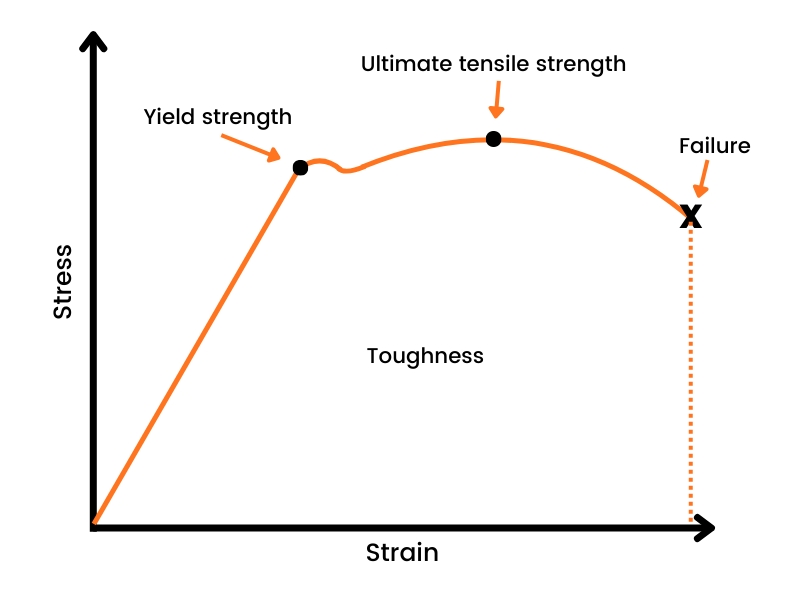
Strength refers to the materials ability to resist deformation or failure under load. There are different types of strength, like yield (the limit where steel stops performing elastically), ultimate tensile (limit to where it breaks), shear (limit to sliding failure) and compressive (its ability to withstand crushing loads).
Structural steels, for example, are judged largely on their tensile and compressive strength because they must carry heavy loads safely. Duh.
Hardness
Hardness measures how well steel resists deformation. So if we cut through to blade steels, for example, this largely determines how well the edge holds its sharpness. Hardness is typically measured using the Rockwell, Brinell or Vickers scale. For hard steels, Rockwell C (HRC) is the most common, whereas Vickers Hardness (HV) is more (but not always) for thinner materials and coatings.
Toughness
Toughness is the ability of steel (or any material for that matter) to absorb impact without fracturing. How is this different from strength, you ask? Well, strength talks in maximum forces and toughness looks at the energy absorbed before it cracks. Glass is a great example of their differences: it’s very strong but not very tough. You can pull it a lot and it won’t break, but stab it with a hole punch and you’ll obliterate it.
Toughness is essential for blades and heavy duty components that experience sudden shocks or repeated strikes.
Generally speaking, hardness and toughness oppose one another. As a steel becomes harder, it usually becomes more brittle and less able to absorb energy before fracturing.

Wear resistance
Wear resistance determines how well steel resists abrasion. This property is mostly influenced by hardness, but also by carbon content and microscopic particles called carbides – which are like very hard pieces of metal (e.g. vanadium, tungsten, molybdenum) and carbon. To continue with the blade example, more carbides typically improve wear resistance but can make the steel harder to sharpen.
Corrosion resistance
Rust ain’t no good for nuttin’. Well, almost nuttin’ (some steels rely on controllable and intentional rust for protection – these are known as weathering steels, but they’re in the minority compared to other steels, so let’s forget about them for the time being…).
Most steel naturally rusts when exposed to moisture and oxygen. Salty moisture can drastically speed this up. So where you and I might go to the beach for some rest and relaxation… steel gets rust and relaxation… (erm… yeah.. I’ll close the door behind me…)
You can improve corrosion resistance by alloying elements like nickel and chromium. When chromium content exceeds ~10.5%, the steel forms a protective passive layer that prevents rust. This is the defining characteristic of stainless steel.
Elasticity and ductility
Elasticity is how much load a material can take and return to its natural position – think temporary deformation. After a certain point – the yield point – the material will behave ‘plastically’, meaning permanent deformation. Ductility, however, describes how far a material can plastically deform before breaking.
In construction, for example, this is an important factor of steel structures so they can safely absorb shocks during earthquakes or high winds, without buying a one-way ticket to snap city.
Machinability
For manufacturing and fabrication, steel must also be practical to work with. Machinability determines how easily it can be cut, drilled or shaped. Weldability and formability determine whether workers can bed and join the material without cracking it. And because most steel components are either joined to other steel components, or edited in some fashion, this is a pretty important factor to consider.
Keep your temper with these steel treatments
Most steels are modified after they’re made to fine-tune how they behave in use. Broadly, there are three big “families” of processes.
Heat treatments
This is where you change microstructure with heat and cooling. You have quenching and tempering, which is where you heat and rapidly cool, then reheat at a lower temperature to set the balance of hardness, toughness and ductility. There’s also annealing, where you heat and then cool slowly to soften the steel and relieve internal stresses, and make it easier to machine or form. Like a cosy steel bath.

Work hardening
Instead of using heat to change properties, you can actually use load. Work hardening can consist of rolling, hammering, bending, even drawing them into wire. This plastic deformation increases hardness near the surface by creating and mixing ‘dislocations’ within the grain structure. Talk about grain expectations…
But, keep in mind if you push too far, you can reduce the steel’s ductility.
Surface-treatments
You can also case-harden and nitride-harden steel surfaces too. This is where you keep a tougher core but harden up the skin. A bit like a chocolate bar, I guess. Mmm.
The functions
Applications of steel change what’s desirable. And although I didn’t mention it above, cost is also an important consideration when picking the “best” steel. Let’s have a look at a few applications and the best steel for them.
Best steel for blade making
Blade making illustrates the trade-offs in steel selection better than most fields. There is no universal “best blade steel”. Instead, the ideal steel depends… shock. But blade steel must balance three core properties, which vary in importance depending on their use:
- Edge retention (hardness and wear resistance)
- Toughness (resistance to chipping and breaking)
- Corrosion resistance
Pocket knives and everyday carry (EDC)
Pocket knives need steels that stay sharp for long periods and resist rust in daily use, and they're generally exposed to different conditions. You might use yours while fishing, and I might use mine to make toothpicks from bits of bark. We need a knife that can do both.
Modern premium knives often use powder metallurgy steels which are made from steel powder instead of a single molten block. These have extremely fine and uniform grain structures, giving you high wear resistance without making the steel as brittle as older high-alloy steels.
Popular, edge-ucating options of blade steels include:
- CPM MagnaCut – widely considered one of the most balanced knife steels available. It combines excellent toughness, strong edge retention, and very high corrosion resistance.
- M390/CPM-20CV/CTS-204P – premium steels known for outstanding wear and corrosion resistance.
- K390 and CPM-CruWear – extremely tough steels with excellent edge retention, though they are not stainless (so less corrosion resistant).
Swords and heavy chopping tools
Large blades such as swords, machetes and survival knives require maximum toughness. If the steel is too hard, the blade can shatter when it strikes something hard. So most sword steels require heat treating and hardening.
For these tools, spring steels dominate:
- 5160 spring steel – famous for its shock resistance and durability and forgiving nature in hard-use blades.
- 9260 spring steel – contains silicon that allows the blade to flex dramatically and return to shape.
- 80CrV2 – a modern favourite for tactical swords due to its excellent toughness and reliable heat treatment response.
Traditional carbon steels such as 1060, 1080 and 1095 are also widely used, especially for blades that rely on different hardening techniques.
Kitchen and culinary knives
Kitchen knives prioritise thin edges and precise cutting performance. So their steels must provide strong edge stability while remaining resistant to corrosion from food acids and moisture. Because rust don’t taste too good.
Common options include:
- VG-10 – a premium stainless steel used in many Japanese chef knives.
- SG2 powdered steel – known for excellent sharpness and edge retention and strong corrosion resistance in high-end kitchen knives.
- AEB-L and 14C28N – stainless steels with fine carbide structures that take extremely sharp edges and resist chipping.
Traditional Japanese steels such as Shirogami (White Paper Steel) and Aogami (Blue Paper Steel) can achieve incredible sharpness but require careful maintenance because they rust easily. So, again, a trade-off between properties.
Marine blades
Then for our final type of blade, the type used for wrestling sharks and kelp under the sea. As common sense would tell you, these blades are used in salt water – a very corrosive liquid for our precious steels. So corrosion resistance becomes the dominant requirement.
Steels like LC200N, Vanax, and H1 use nitrogen-rich metallurgy to achieve near complete resistance to saltwater corrosion.
Best steel for construction and building
In construction, steel must safely support enormous loads while remaining flexible enough to handle varying types of stress (e.g. static loads from its own weight, cyclic loads from wind and even traffic). Different parts of a structure therefore use different steels optimised for strength, fatigue resistance and ductility depending on what they’re exposed to.
Reinforced concrete structures
Concrete is very strong under compression by weak under tension. So, to compensate, builders reinforce concrete with steel bars so the steel carries tensile and bending stresses.
In the UK and Europe, high-ductility reinforcement is specified with grades like B500C (under BS 4449), which offer greater elongation and controlled tensile behaviour in critical zones.
In the US, that often means using seismic-grade rebar like ASTM A706, which is specifically designed for better ductility and weldability in earthquake-resistant structures, compared with more basic A615 bars.
Structural steel frameworks
For beams, columns, and trusses, structural carbon steels are preferred because they offer strong load capacity and excellent weldability. We can truss them, alright.
Common grades in the UK and Europe include:
- S275 – a general purpose steel used for lighter beams, columns and plates.
- S355 – the most widely used structural grade, offering higher strength for typical building frames, bridges and heavy sections.
- S460 – a high-strength structural steel where long spans, heavy loads, or weight savings are critical.
- S235 / S355 hollow sections – commonly used for structural tubes and box sections.
And in the US:
- ASTM A36 – the everyday workhorse for general construction
- ASTM A992 – widely used for wide-flange beams in modern buildings
- ASTM A572 Grade 50 – a stronger low-alloy steel used for heavy loads and large structures.
- ASTM A500 Grade B – commonly used for hollow structural sections like tubes and box columns.
These steels provide an excellent strength-to-weight ratio, allowing architects to design large open spaces and make the ultimate beam team (of fewer supporting columns and beams).
Best types of stainless steel
Now we have a large family of steels, the complete opposite to me after a Sunday lunch… stainless.
All stainless steels, as we saw earlier, contain at least 10.5% chromium which forms a protective oxide layer that prevents rust. Some also contain nickel and other alloying elements to change corrosion resistance, formability, strength and cost. So again, the application largely dictates which stainless steel is the best fit.
Rather than looking at applications, I think it’d be better to look at popular grades and see what they’re used for.
General purpose stainless steel: Type 304
Type 304 stainless steel is the most widely used stainless alloy in the world. Often called 18/8 stainless, it contains roughly 18% chromium and 8% nickel. This combination provides a warming balance of corrosion resistance, strength, and affordability.
(Side note: if you check your cutlery, you’ll sometimes see 18/8, 18/10, or even 18/0. As a rough rule, the higher the nickel content, the fancier the set. Lil’ party trick to impress your friends courtesy of my old lecturer)
18/8 is commonly used for:
- Food processing equipment
- Sinks and cookware
- Kitchen appliances
- Indoor architectural components
Marine and chemical environments: Type 316
When exposed to saltwater or aggressive chemical environments, 304 can suffer from pitting and crevice corrosion. Type 316 stainless steels add molybdenum to the alloy, which dramatically improves resistance to chlorides… because the last thing you want is your propeller turning to dust mid-way across the Atlantic.
This makes it the preferred steel for:
- Marine hardware
- Boat fittings
- Coastal architecture
- Chemical processing equipment
High-strength stainless steels
For the heavy-duty, heavy-load jobs, stronger stainless steels are necessary. Duplex stainless steels combine two metallurgical structures (austenitic and ferritic), giving roughly double the strength of standard (austenitic) stainless steels and superb resistance to stress-corrosion cracking.
Precipitation-hardening grades like 17-4 PH stainless steel can be heat-treated to extremely high strength levels, while still offering good corrosion resistance – and are widely used in aerospace and precision engineering.
Best steels for general use
For general fabrication, and everyday manufacturing, the ideal steel is one that balances affordability, strength and ease of use. We have one main option:
Mild steel
Low-carbon steels such as S235 and S275 (or A36, 1018, 1020 in the US) are the most common general-purpose steels. These steels are easy to cut, weld, drill, and bend with enough backbone for everyday structures without being fussy to work with.
Typical uses include:
- Frames and brackets
- Machinery parts
- Furniture and fixings
- Structural fabrication
- Even your frying pans
Alloy steel upgrades
When higher strength or durability is needed, alloy steels such as 4130 or 4140 (and their EN equivalents) provide improved toughness while remaining workable. They offer a big jump in toughness and strength compared to mild steel, while still being machinable and heat treatable for demanding parts. You’ll typically see these in:
- Mechanical components (shafts, gears, pins)
- Automotive parts (suspension, roll cages)
- Industrial and hydraulic equipment
Now, the question you’re probably wondering – at least, we were…
What’s the best steel for precision-engineered tools or fidget toys?
The modern mechanical desk toy, and EDC tools occupy a unique space between function and tactile objects. They must feel smooth and precise while also having to bear the real mechanical forces between your fingers and life.
So, in our creations we use several depending on where and what it does and looks like.
For example, in main bodies and outer components, we primarily use 316 stainless steel. This appears in our beloved MetMo Cube, Fractal Vise, Pocket Driver, Grip and Piston.

Compared with standard 304 stainless steel, 316 adds molybdenum, offering improved corrosion resistance (for those sweaty palms) and a cleaner, more over-engineered finish that will literally last until the end of time.
Where components have to bite and hold, and generally use more force, we opt for harder stainless steels. So for clamping jaws and high-load parts, martensitic stainless steels such as 420C and 440C become our go-to. These can be heat treated to high hardness, shrugging off repeated tightening with ease.
Inside ratcheting systems, like the Stainless Steel Driver, we use D2 tool steel hardened to around HRC 55. This gives them the wear resistance they need for thousands of cycles.

And then other components are chosen for strength and durability. The helix shaft in our Grip, for example, is made from 1020 carbon steel for its ability to handle heavy clamping forces.

Signed, steeled and delivered
There we have it: a whole toolbox of steels for a whole toolbox of jobs. There’s no “best” steel for everything, only the right steel for the job at hand.
Blade steels juggle edge retention, toughness, corrosion resistance. Construction steels have to shoulder heavy loads while staying ductile enough to absorb stress. General fabrication steels lean into affordability and workability. And even our specialised tools and precision fidget devices use a small steel orchestra.
So, in the end, good steel choice comes down to three questions: where will it live, what forces will it face, and which properties you’re willing to trade to get the ones you need.
Hope you enjoyed reading this, if you did, or you have some steely questions, pop them in our CubeClub or Subreddit. We’d love to iron out the details with you.
Until next time.

Share:
Taking the 5 best metal fidget toys for a spin
17+ Father’s Day gift ideas for 5 types of dads in 2026