

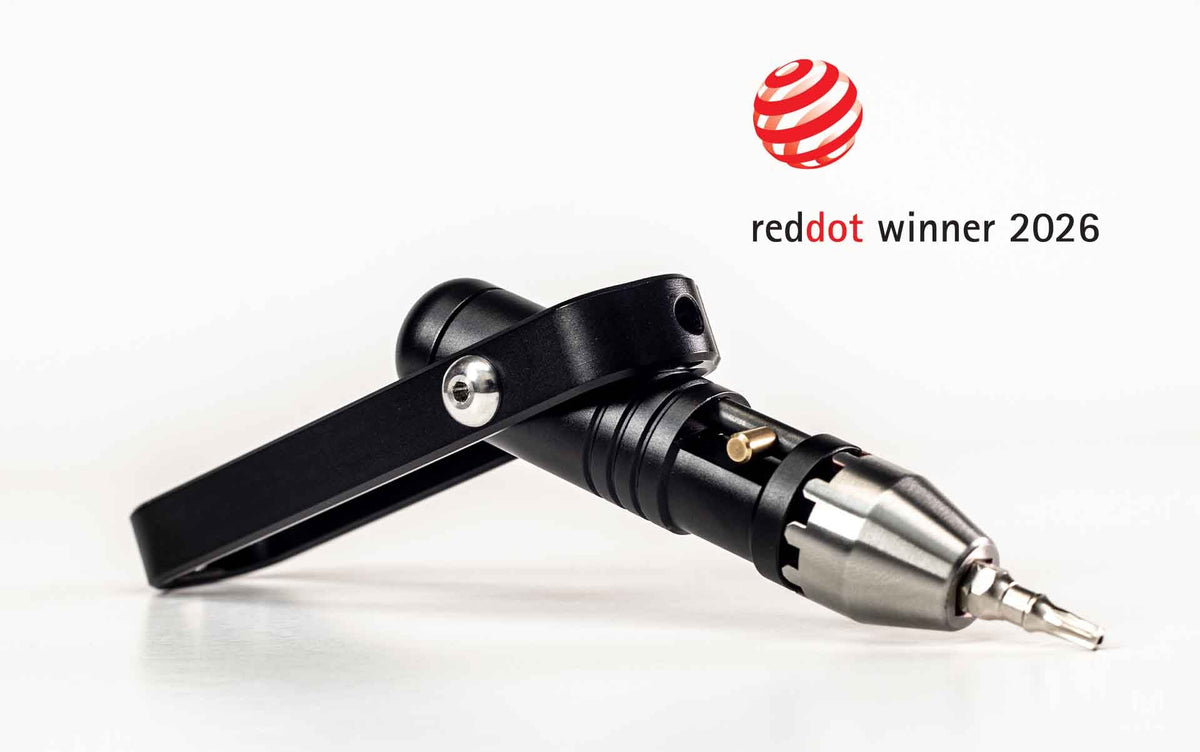
Read the title. Read it again. Again. Okay, once more. That’s right. We’ve won a bloomin’ Red Dot Award for Pocket Driver.
I know I could have led with something mysterious, kept you guessing for a bit and revealed towards the end in true article fashion… but some news is just too good to bury. And it still hasn’t really sunk in.
So in the spirit of a proper thank you, we figured we’d share the story of Pocket Driver, and the whole journey it took to get here, award and all.
To do that, though, we need to drive the clock back. Not to last year, or even last decade… but all the way back to a small town in Germany, some time in the late 19th century.
Let me set the scene…
Christmas without the snow
Our journey starts in Remscheid-Lüttringhausen, a small district in western Germany’s Bergisches Land. From the outside, it’s beautiful — steep wooded valleys, wet weather, narrow streets, brick-and-slate buildings. Proper Christmas but without the snow kinda vibes. Step inside, though, and it becomes even more beautiful. Not for the German sights and smells, but for the constant, soul-caressing clangs of metalwork.

Source: OpenStreetMap
For a long stretch of history, our humble Remscheid-Lüttringhausen was the centre of the German toolmaking industry. The valleys, thanks to the reliable rainfall, were cut through by fast-flowing streams, which since the 15th century had powered the district’s hammers and grinding shops. Reportedly, there were over 62 water-powered hammers and 215 smithies by 1801.
But Lüttringhausen was not exclusively toolmaking. The district also had 6 tanneries, 102 ribbon looms, and more than 100 independent carriers hauling its goods to various markets.
(Remscheid actually earned the nickname “Seestadt auf dem Berge” — the seaport on the hill. Around 1800, one local merchant house reportedly ran some 20 oceangoing ships. And rail-connected freight served many firms well into the 1960s! So export was also a huge part of the local economy.)
Over time, though, the local economy shifted, moving from scythes, sickles and knives further towards steel goods, tools and small ironware. And when steam power arrived around 1850, steel and hammer works — toolmaking above all — grew to become its major industries.
Connected to the world and hearing all the stories from overseas experiences, you can only imagine what it would have been like to grow up in a region like this. One man did (although the records don’t state when exactly, but likely ~1870s).
His name was Conrad Baumann.
It does what it says on the tin
In the late 1800s, possibly 1891 (again, the date is unconfirmed), Baumann opened a tool-making business. He creatively named it “Conrad Baumann Werkzeugfabrik” — literally “Conrad Baumann Tool Factory”.
The world was building stuff, and manual fastening was everywhere… workshops, machinery, carpentry, wagons, buildings, agricultural equipment, bicycles and even early cars. And immersed in that world, our good friend Herr Baumann identified a problem with one of the most trusty tools: the screwdriver.
Under load, it was slow, and it had a tendency to slip when the user had to alternate between pushing downwards and turning hard. (Need I remind you, this was long before Milwaukee Hole Shooters and electric drills.) So Baumann invented something to fix it.
What he created was quite possibly one of the most overlooked and underappreciated tools of human-mankind-in-existence ever…
The Baumann-Weltrecord ratchet screwdriver.
Ratchet me this
Why it was called Weltrecord (or sometimes, Weltrekord), we will never know. It directly translates to “World Record”. Which, understanding the time, culture and connectedness of Lüttringhausen in the late 1800s, could have been to put his stamp on the world and help others trust and buy his screwdriver without seeing it.

Name as seen on a later 70s model
This was a time when workshops survived by solving one narrow problem better than their neighbours (a cleverer ratchet, a more spannery spanner, a filey-er file, etc, etc). This wasn’t a world of free trials, influencers, personal brands, and Reddit reviews either. Buyers bought tools through illustrated catalogues, travelling salesmen, and local ironmongers, relying solely on the information immediately available. So a bold name helped.

The one on the left is an early 1900s model
These tools ended up in the hands of joiners, fitters, mechanics, maintenance workers and engineers — basically anyone who spent their working life building and fixing things. They were expensive relative to wages (some things never change), so longevity and reputation mattered. Repairable mechanisms and replaceable parts were also a huge part of the pitch. If it broke, you could fix it yourself. Excellent.
That kind of design invited curious minds. They could take them apart, figure out how they worked, and investigate them until their fingers went numb.
And by the time Baumann had come onto the scene, ratchet screwdrivers were likely one of those things such minds had been curious about. You twist your wrist to drive the screw, like any other screwdriver, twist it back, and the ratchet clicks free without undoing your work. Simple. US records show a ratchet mechanism as early as 1858, with several more ratcheting-driver patents filed through the 1860s.

1858 patent for ratchet mechanism. Source: Google Patents
Then, by the late 1890s, the Yankee push/spiral screwdriver turned the idea into a mass-market success, becoming one of the most successful alternatives to a conventional screwdriver. (North Brothers acquired the business in 1895 before Stanley acquired it again in 1946).

Yankee screwdriver mechanism. Source: Google Patents
Still, Baumann thought he could do better.
He added a fold outside handle — a drive arm — turning the tool into something between a brace and a screwdriver. Instead of relying on wrist rotation alone, you could brace the body against the screw with one hand and rotate the folding arm with the other. This was one of the earliest examples of combining a ratchet mechanism with a mechanical drive handle in a single pocket tool.
Early Weltrecord drivers carry D.R.G.M. (Deutsches Reichs-Gebrauchsmuster) marks: Germany’s Imperial Utility Model registration system. And a surviving 1942 catalogue lists the tool, proving it was still being sold deep into the war.
Remscheid, being the major industrial area it was, was heavily bombed by the RAF during the Battle of the Ruhr. And despite severe disruption, Baumann’s business pulled through, and he filed a US patent for the tool in 1950. He described it as a ratcheting screwdriver with removable bits and an independent drive handle — the core Weltrecord format, laid out quite literally in black and white.

The original patent drawings from 1950
A 1959 patent tied the post-war design back to the earlier D.R.G.M mark, linking the old and new Weltrecord families together. Then, in 1967, a more refined version was published: a smaller mechanism, moulded plastic handles, a collet-type chuck, and stamped with the patent number instead of the old D.R.G.M mark. Kind of just making the most of modern techniques. Some surviving examples (as I’ll show you shortly) had weak or seized collet chucks, suggesting some durability issues sadly crept into later evolutions.

The iconic patent stamp
The last known record is from 1975. This was an official certificate allowing the company to supply the US government. Beyond that, the trail goes cold. Electric cordless drills entered the market, and the production of Weltrecord’s ceased after roughly 70 years...
And it seemed as though this exciting tool was to fall into the cold, unforgiving hands of toolbox darkness, only to be forgotten about forever…
That was until the early 2020s when a bustling team of designers and engineers in Leeds — a city that also knows a thing or two about wet weather and metalwork — decided to find out what they could do with it.
A team that was, by all objective accounts, devastatingly good looking, brimming with character and creative ideas, and quite frankly in possession of the best sense of humour the North of England has ever seen.
That team was us. (And modesty was never our strong suit.)
In the hands of MetMo
By the time we’d got our hands on Baumann's Weltrecord, we were 4 products deep. We launched on Kickstarter in 2019 with the MetMo Cube, and thanks to our incredible backers, beat our £5000 target by 487%. Then came Helico Mk1, which smashed its target by 491%. The fire in our belly to design and make cool stuff was truly lit.
Next came Grip. This was our first tool, reimagining a 1929 Monkey Wrench patent. We spent months tearing the idea apart, finding ways to overengineer every component, so it would be indestructible and last for centuries. (We back everything we make with a 200-year guarantee). We also designed in multiple functions for different EDC scenarios — a clamp, a drive bit holder, a nut clamp, bottle and box openers, and because the jaws are 316 stainless steel, they make a pretty tasty hammer too.
The response from our backers blew our mind. Brain guts everywhere.
Our £5000 target ended up reaching over £380,000. And if the fire was lit before, I can confidently say it was blazing now.

Our 2k20 Blazin' Squad
We still loved making fidgets and cool contraptions to keep your fingers busy. So we began to alternate our focus between fidgets and tools. The following year we launched MetMo pen, which exceeded its targets by an absurd 3061%.
And then the year after came the big one.
Quite literally.
(Side note: I really want to reiterate that none of this would have been possible had it not been for all your support and buying the stuff we make. You guys literally let us live our dream.)
The MetMo Driver
Faced with a blank sheet of paper, we sat down as a team to decide where we wanted to go next. We rattled through patents, tool forums, workshops, all sorts to see what we could find.
And then we discovered Baumann’s Weltrecord ratchet screwdriver.
Its interesting history scratched itches we didn’t know we had — mixed patents and designs, its unclear ending and origins, and now a limited availability made it feel like we’d stumbled across something rare. We wanted to bring this soon-to-be-forgotten invention back to life, and over-engineer as much of it as we could.
But to do that we had to get our hands on one and take it apart to find out how it actually worked.

Up close and personal with the chuck’s snoot
We managed to get hold of two. One very early 1900s model and a later 1970s version. We spent 6 months collecting, studying, and reverse-engineering this beautiful vintage German tool. It turned out to be better than we expected. Its exposed switchable ratchet mechanism, a swinging drive arm, and interchangeable bits made it very fun to play with. It was like a beam of warm, fuzzy feelings that tingled down to our toes.

In use
But the more we tested, the more we found some of those mid-century durability flaws that crept in. Collet chucks frequently seized, a reliance on obsolete proprietary D-shaped bits, sticky rotating handles, and a limited torque capacity (~20 Nm). Sure, it was ageing. But not like fine wine. And if we, or others, wanted to seriously use this tool, we were going to have a hard time doing so.

The bits that came with the later version. The Weltrecord only worked with the supplied bits!
We saw this as a clear opportunity. We were going to take this century-old mechanical treasure and completely modernise it for the 21st century.
A deep drive into developments
To start, we converted the design into 3D using SolidWorks, refining every dimension, ratchet tooth geometry, handle interlock, and spring size on screen before cutting any metal. Using rapid plastic 3D prints, we tested how the tool felt in hand (while plastic couldn’t take heavy structural loads, it allowed us to dis/assemble wall sockets and refine the physical mechanics pretty quickly. Fail fast and all.)

The trusty pen and paper
Through computerised load simulations, we re-engineered the material specifications from the ground up to eliminate any of the historical failure points. We upgraded the main body to 7055-T77 aerospace-grade aluminium — an alloy developed for aircraft that offers steel-like strength without the weight or risk of stress cracking.

Colourful testing
The chuck was machined from hardened martensitic stainless steel, with CNC-cut compound angles on the castellations to eliminate rotational twisting friction. We quadrupled the contact area of the reciprocating barrel pin using high-chromium tungsten tool steel, added a custom brass bush to eliminate handle friction, upgraded the direction catch to a knurled brass adjuster pin and replaced the old collet system with a universal ¼” magnetic hex drive using a recycled neodymium magnet. Boom.

Prototype in progress
Together, these overhauls boosted the drivers and maximum torque threshold from 20 Nm… to an incredible 76 Nm. (The same as a 1982 VW Polo)

POWER (Torque)
Before committing to full-scale industrial manufacturing, we need to prove the build in raw metal. Our master metal worker Geoff spent 42 hours across six days in the “MetMo Shed” machining the very first working metal prototype by hand. During this stage, we also experimented with a removable handle that stored bits internally. Practical testing proved otherwise. It would have needed an ultra-strong magnet or release buttons, which would have ruined the tool’s sleek aesthetic and added cost with little functional benefit. So we scrapped the idea. And kept the clean iconic handle profile.

Unfortunately not to be
To verify our digital load simulations in the real world, and without access to power test machinery, we built a custom lever test rig mounted on a heavy railway sleeper bed loaded with 100kg. The driver proved so tough that our biggest battle during testing was stopping it from snapping test bolts or stripping their threads!

The test rig
Once we finalised the arm thickness and heat treatments, we launched our crowdfunding campaign to move into mass production.
Over 7,000 amazing backers joined us, raising 1.2 million pounds. Errr… C.R.A.Z.Y.

Our Kickstarter
Delivering the Driver to backers around the world was a massive milestone for us. And as people started putting it to work, a new conversation began brewing on our community forums…
Could we make it pocket-sized?
We realised that bringing this mechanism into a micro-realm of EDC for Allen keys, flat pack furniture and tight single-handed spaces wouldn't just be a case of making the parts smaller… it would mean rethinking the handle, the grip geometry, and the mechanics from the ground up.
So we got to work.
The Pocket Driver
Again, after some finger tinkering and sketches, we started in SolidWorks mapping out proportions and running computerised stress analysis to understand where loads would concentrate and to engineer safe failure limits into the handle structure.

Back to pen and paper
To test physical ergonomics in our hands, we ran more rapid plastic 3D prints. We initially attempted a U-shaped handle like the original driver, but it proved far too unwieldy for single-handed use, so we quickly pivoted into a pistol grip layout. Pew Pew.

Simulations
It took us three separate 3D-printed handle pivot modifications to perfect the hand feel. The final geometry yielded a full wrap-around handle supporting four versatile grip modes — inline, offline, T-grip and pistol grip — along with an internal handle cavity holding 2 x 25mm hex bits. To refine the mechanism for delicate work, we increased the chuck castellations from 8 to 10 for finer engagement, incorporated precision-ground custom shoulder screws as bearing surfaces and engineered a coarse-threaded end cap with a press-fit ball plunger to deliver satisfying release clicks.

New, smaller chuck
Before committing to mass manufacturing, again, senior engineer Geoff had to step back into the “MetMo Shed”. Only this time he spent 54 hours over six days, machining the very first Pocket Driver prototype by hand from raw mild steel, brass and aluminium billets. (Full video here)
Hand-machining threw up its share of problems — three screw caps, a couple of barrel pins and one whole arm (on Pocket Driver, not Geoff). But it was worth it. It let us remove burrs around the chuck, test tolerances, and calibrate spring strength before automated tooling got involved.

Making the prototype
When our 20-unit pre-production run arrived, physical stress testing exposed some hiccups the CAD simulations had missed. First, theoretical ball plunger tolerances failed under sideway loads, crushing the plunger housing and permanently jamming the ball. Not good. So we quickly expanded housing clearances and added side load protection.
Second, putting drivers under extreme load revealed a structural weakness where the M3 brass pin handle screwed into the barrel pin. Also not good. So we reduced the thread to M2 to preserve wall thickness and eliminate the failure point.
Third, to prevent the ratchet from back-driving delicate micro-screws, we achieved a featherlight ratcheting action by reducing the spring diameter, polishing the barrel pin tip, and adjusting glide meeting angles.
And finally, when CubeClub members pointed out that installing our screw-in barrel extender left the end cap loose, we modified the extender so the original end cap screws directly into the base.
It’s all fun and games at MetMo, eh? Always.
But the feedback and soft launching with MetMo VIPs proved invaluable.
We launched across Kickstarter and Indiegogo, quickly building a following of makers, cyclists, and EDC enthusiasts, and before long we’d raised over £1 million from more than 5,400 backers. Making it one of our highest-backed launches ever!

The success and visibility of the Pocket Driver campaign unfortunately made it a target for counterfeiters and scammers online. So to protect the design and backers, we introduced laser-engraved Weltrecord markings on the stainless steel components. One final nod to Baumann.

A homage to Herr Baumann
But as a surprise to us, the Pocket Driver’s success didn’t end there. We were fortunate enough to win a few awards, including some full-circle German recognition too:
- German Design Award
- German Innovation Award (Excellence in Business to Consumer - Gardening & Tools
- Gold Winner at London Design Awards
- Top Design Winner in Industrial/Tools: Hand Tools & Equipment at European Product Design Award (EPDA).
We’re incredibly proud of the team for all their (our?) hard work to make this a reality. And again, we couldn’t have done it without all our amazing MetMo-ers continued support.
But there was one more James and Sean had circled, long before MetMo ever existed. An award that I don’t think any of us had ever planned on winning. (It’s the same award previous winners like Apple, Dyson, Ferrari, Fiskars, Bosch and many more big names have picked up over the years). Brands that have proved how everyday objects can be made more useful, more beautiful, and of course more enjoyable to use.
And now somehow, we’re on that list too.
With a sensible amount of drum roll, please…
MetMo has won a Red Dot Award for Pocket Driver!
Yep. Mental. None of us has any arm skin left to pinch ourselves.
If you’re not familiar with the Red Dot Award, it’s one of the world’s best-known design awards. It has been recognising exceptional (eeek) product design since 1955.
Products are assessed by an independent international jury of designers, design professors and specialist journalists — and they look at far more than whether something looks nice on a shelf. Innovation, functionality, usability, durability, materials, quality and how clearly the design communicates what it is made to do. Everything we’ve obsessed over for years.

Close up of the jury’s statement:
“The MetMo Pocket Driver fascinates with its compact construction, striking mechanics and an aesthetic that visibly turns versatility into a guiding principle.”
- The Red Dot Jury, 2026
For a small Yorkshire team that started out making a tiny mechanical cube, this is a wonderfully big slap-yourself-in-the-face moment, one we’ll be talking about for decades to come. We still cannot quite believe that something built around the same principles we have always cared about – clever mechanisms, honest (over-engineered) materials, satisfaction, and objects made to be used for generations — is now a Red Dot Winner.

It suits, doesn’t it? Hehe
If you’d like to investigate the Pocket Driver in all its forms, you can here.

Thanks for reading guys, and one more time, thank you all so much for your support and allowing us to spend our days making, breaking and re-making cool stuff. We wouldn’t be here without you.
– Everyone @ MetMo
Share:
A sprue-pernatural toolkit for beginner model making