

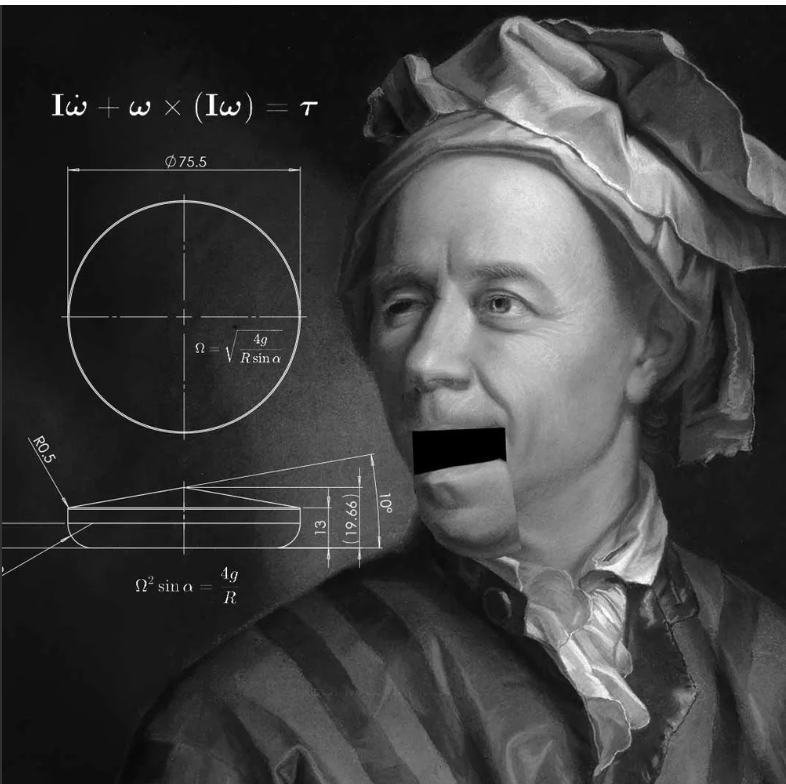
A 29-year old Swiss mathematician, at the time working in St Petersburg, sits with a stack of geometric proofs. It's some time around 1736. And he has decided (as any young aspiring mathematician might) that he’d like to describe motion using calculus instead of geometry.
At this point, largely thanks to Isaac Newton, laws of motion are familiar and transforming how people understand the physical world. But they worked largely with ideal particles: objects of no shape or size. In other words, point masses.
Of course, the world is full of objects that are not points. Pendulums swing, spinning tops wobble, and wheels turn. And as they did, all of them stubbornly occupy three dimensions.
Fortunately, one curious fella decided he wanted to investigate further.
And he did. With great success. Over the following decades, he developed the general principles of rigid-body dynamics, became a leading figure at St Petersburg and Berlin Academies, won the Paris Academy’s prize competitions an extraordinary 12 times… AND was elected a Fellow of the Royal Society in London.
But not even he could have calculated that, some 250 years later, he would receive his most honourable recognition yet. Being named after a science toy.
The gentleman’s name? Leonhard Euler. And the toy in question? Euler’s Disk. Which, as you’ll soon see, is not just any ol’ science toy.
Let’s start with the basics…
What is Euler’s Disk?
In two words: desktop sorcery. In a few more: a scientific educational toy that spins and rolls for a long time. In even more words: It’s a toy that has two components, the disk, which spins and rolls, and a flat or slightly concave reflective surface which the disk… er… spins on. When it does, it makes a rather riveting rattling sound that rapidly rises in pitch before coming to an abrupt stop. (I think “clack” is the correct adjective)

The official Euler’s Disk is a solid, chrome-plated steel disk about 7.5cm in diameter and 1.3cm thick, weighing roughly 400 grams. So it’s noticeably heavier and denser than a coin of the same size (which spins for only a few seconds by comparison). Much like my Christmas turkey, its mass matters. Why? Because, well unlike my plucked lunch, it’s mass that keeps the disk’s stored energy high enough to spin and spin and spin and spin.

One edge of the disk is machined flat. The other is rounded into a smooth bevel. That rounded edge is almost the crux of Euler’s Disk. (Something we toyed with when we developed our Singularity Disk with Steve Mould). It’s what the disk rolls on, and a smoother, rounder edge means it wastes less energy through rubbing, slipping, tiny impacts and microscopic deformation. Less resistance means a longer spin.
Euler’s base
Of course, spinning and friction are best-buds or arch nemesises depending on how you look at it. For Euler’s Disk, they’re the most mortal enemies. And friction takes two to tango.
So the material that the disk spins on plays an important role in its duration. It needs to be hard, smooth, flat and clean, which is why the disk usually finds itself on a glass mirror base. It’s somewhat affordable and about as low friction as you can get on a desk. Unless, of course, you wanted to spin it on some single-crystal super-polished sapphire… maybe something for the future…
Anyway, the plate is flat or slightly concave to keep the disk from going walkies.
How long does it spin?
Most Euler’s Disks usually spin for 60-120 seconds, depending on the launch, surface cleanliness, rim condition and how level the base is. But that’s just the standard version…
As I’ll show you later, with some special engineering-know-how, an unhealthy obsession with friction, and a spoonful of MetMo x Steve Mould magic, that time can increase to well over 3 minutes…
A motion so good they made a new word for it
The disk’s motion is a mix of two. And some very creative folks, at some point in history, decided to use their creative minds and give the motion a very creative name: spolling.
(Side note: this word is a good example of a portmanteau. A type of word that is formed by combining parts of two or more other words. In our case, spinning and rolling. Another could be brunch, or spork, or hangry.)

Euler’s Disk doesn’t spin in place around a fixed axis like a spinning top does. Instead, it rolls along its circular edge while its centre sweeps around in a circle of its own. That sweeping motion is called precession.
Precession is one of the key reasons the disk looks and moves so strangely. As the disk falls closer to the base, its centre sweeps around faster and faster. The wobble tightens, the sound rises and the whole becomes super dramatic, right up to the point when it stops and ‘clacks’ flat on the mirror.
Before I pamper you with equations and symbols, I want to first spoll back the clock and show you the history of Euler and his disk.
(Spoiler: they never met)
The 18th Century origins
In a time when doctors still prescribed bloodletting, London was drowning in gin cheaper and more accessible than clean water, and a horse was the fastest thing a human could travel by, our good friend Herr Leonhard Euler (1707-1783) was building general principles of rigid-body dynamics.

By now, Newton’s laws of motion existed. And they had transformed how people understood the physical world. But they were most easily applied to idealised point masses: useful mathematical objects with mass, but no size, shape or inconvenient urge to spin, wobble tumble — or, eventually, spoll — through three dimensions.
Euler set out to extend this machinery to real ‘extended’ objects. Objects with shape, mass distributed across them, and most importantly, the ability to rotate.
His 1765 work, Theoria Motus Corporum Solidorum Seu Rigidorum (Theory of the Motion of Solid or Rigid Bodies) laid down what are now Euler’s equations of motion, along with a framework for describing 3D orientation known as Euler angles. Today, these are used to model all sorts — from gyroscopes and aircrafts to satellites, robots and spacecraft.
But it took over 200 years for them to explain our beloved disk.
The invention of Euler’s Disk
So, Euler’s work integrated itself into countless facets of life. But it was the year of 1987 that Joseph Bendik, an aerospace engineer at Hughes Aircraft’s Carlsbad Research Center, had a fortunate mishap with polishing chucks.
He was expecting metrology tools for a micromachining experiment. But instead received 12 shiny, sharp-edged polishing chucks. These were heavy circular components. And being the curious chap that he was, occasionally dabbling in the wonderful art of fidgeteering, Bendik realised that these chucks span for far longer than a coin.
He was also fascinated by the noise it produced. So much so, Bendik called a colleague, Richard Henry Wyles, over to watch, then phoned his friend, Larry Shaw — the inventor of the Astrojax toy — so he could hear the sound himself down the line.
What followed was several years of highly productive fidgeteering and experimentation.
Bendik, Wyles and Shaw tested different disk geometries, heavy steel lathe weights, glass surfaces, and strobe-light setups, chasing the longest possible spin time. By 1990, Bendik had trademarked the refined design and brought it to market through the Tangent Toy Company, naming it Euler’s Disk as a nod to the mathematician whose two-century-old equations had, it turned out, predicted the whole thing.
But before long, the toy left its cosy cave of curiosity and prompted debate among the experts…
Why does it make that sound — and why does it stop so suddenly?
FIGHT
In April 2000, Cambridge fluid dynamicist Keith Moffatt published a short paper in Nature titled “Euler’s disk and its finite-time singularity” which pulled the toy into academic debate about exactly why it stops the way it does.
Moffatt argued that it was air. As the disk settles closer to the table, it traps an even thinner wedge of air beneath it. That air is sheared between the rapidly moving disk and the stationary surface, producing viscous drag. In Moffatt’s model, this loss becomes increasingly severe as the gap narrows. Which was enough to explain the disk’s abrupt final collapse, even while its precession rate appears to race towards infinity.
It’s an elegant explanation, and it matched his own measured spin times reasonably well. He also noted that this air effect should only become the dominant factor in the very final fraction of a second before the disk stops.
But later experiments complicated the picture.
Physicists at UCSB ran the disk in a vacuum chamber and found it still stopped abruptly. Air or no air. That result suggested air drag could not be the whole story. At least, not across the full duration of the spin.
Then, in 2002, researchers used high-speed video to study disks and rings on several surfaces with different frictional properties. They found that the precession rate rose as a power law as the disk approached its stopping time. But the rate and total spin time changed systematically with surface friction. They concluded that rolling friction, rather than air drag, was the main source of energy dissipation in their experiments.
A related study, published in Physical Review E in 2004, tracked a spinning disk’s tilt angle, angular velocity, and precession over time. It likewise found evidence that real contact behaviour — rolling resistance and intermittent slipping at the rim — was central to the disk’s energy loss. Crucially, the authors could not rule out air drag in the final, roughly 0.01 seconds, after their measurements could no longer resolve a full wobble.
As of now, this debate is ongoing. Research published as recently as the mid-2020s still describes the exact dissipation mechanism as controversial, with new studies proposing that friction and slipping dominate early in the spin while air drag only takes over in the disk’s last moments.
For something that seems so simple, Euler’s Disk has kept physicists busy for several decades. Which brings us, finally, to the physics of the disk.
The Physics of Euler’s Disk explained
As you stand the disk up on its edge and tilt it slightly, three things are happening at once:
Gravity creates a torque
The disk’s weight pulls its centre of mass downward, while the surface pushes back up at the single point of contact on its rim. Because those two forces act at different points, they generate a torque. Rather than simply toppling the disk over, that torque makes its spin axis sweep around in a circle.
This, as we saw earlier, is precession. And it's the same basic effect that keeps a gyroscope upright. Euler’s Disk is just a particularly dramatic, noisy, low to the ground example.
The motions are coupled
As it precesses, the contact points trace a circle on the surface. In an idealised version of the motion, where the disk rolls around that circle cleanly rather than slipping, the disk’s motion is constrained by geometry.
This locks together three conditions (conditions that you’d expect to work independently):
- How fast it's spinning on its own axis
- How fast its axis is precessing
- And how steep its tilt angle is
It's not that they are literally locked together, and all change in unison. But rather that they’re ‘mathematically forced’ to move as a single, coupled system. You cannot just choose one and dial the others. This is why the disk’s behaviour looks so weirdly coordinated… the disk slows in one sense, accelerates in another, falls closer to the table, and produces an increasingly high-pitched sound… all at the same time.
Energy is constantly converting and leaking
This isn’t exactly rocket science but it’s important nonetheless. When the disk is tilted higher, its centre of mass sits higher too, storing gravitational potential energy on top of its rotational energy. As the tilt angle shrinks, that stored energy feeds the ongoing motion.

But this, obviously, isn't a closed loop. Real disks leak energy the whole time, through rolling resistance at the contact point, tiny amounts of slipping, air resistance, and microscopic vibrations from surface imperfections. The steady loss of energy here is still what researchers are fighting about, although however it does it, is what eventually brings the disk down to a halt.
Why does the sound and speed increase as the disk slows down?
This is the part that sounds confusing and is gloriously counterintuitive. The disk is losing energy the whole time. Yet its visible wobble gets faster and its sound rises from a low rattle to a high-pitched whirr. The reason is the relationship between tilt angle and precession rate. In a simple, late-stage, small-angle, ideal-rolling model:

As ɑ gets smaller, sin ɑ gets smaller too. So Ω must increase sharply to keep the relationship balanced. In other words:

The disk may be slowing in terms of its overall stored energy, but the direction of its tilted axis is sweeping round faster and faster. That increasingly rapid precession is what you hear as the rising hum, then the high-pitched zip immediately before the ending.
The “infinite” wobble that never happens
In a strict mathematical model, this predicts that the precession rate rises towards infinity in one exact calculable instant. A single-time singularity. In practice, nothing physical actually reaches infinite speed (except, maybe, me eating my christmas turkey). Long before that point, the disk’s vertical acceleration would need to exceed gravity itself to keep up with the model, which is impossible. So something else has to intervene.
Deformation.
This means the disk deforms slightly, starting to slip rather than roll cleanly, and the whole idealised setup collapses. That’s the abrupt clatter at the end.
Onwards. I said earlier, how I’d show you some clever engineering-know-how that could make Euler’s Disk spin for over 3 minutes.
Now’s the time.
MetMo x Steve Mould: Singularity Disc
After Steve Mould shared an excellent video on our Cube, we reached out to see if he’d like to collaborate on anything. Being the wonderful soul he is, he did.
We decided to investigate why certain disks spin for longer than others — and a year or so later, we ended up with Singularity Disc.
This development was very much an iterative process. We wanted to improve spin times by tweaking design factors like…
Mass distribution (we tried ring shapes to reduce contour friction, but physical testing revealed that a simple disc and cone-profile disc were more effective)... We adjusted edge roundness (sharp radii = increased pressure and deformation so no good). Optimum roundness of ~1mm radius was best at reducing contour friction.
Then we tried different base materials, with glass outperforming steel because it’s more elastic and returns more energy to the disc rather than deforming plastically.
Of course, we tried different disc materials too. We ended up with tungsten for the simple disc and stainless steel for the cone-profile. (Because of its density, it allows for more kinetic energy at the beginning of the spin)
And finally, we added three legs to the base to help prevent energy loss through wobble.
It was an extremely fun process and Steve has gotten spin times over 3 minutes. His video on it here:
If you’d like to learn more about Singularity Disc, you can here.
Euler be back
And there we have it. Euler’s disk. A rare case where the theory came centuries before the object. Woop.
I hope you’ve enjoyed reading, if you have come over to our subreddit and let us know. (Or CubeClub if you prefer)
See you in the next one.

Share:
MetMo Wins Red Dot Award for Pocket Driver