

It’s a Tuesday night. The bar is quiet. The kind of quiet where you start doing things for a packet of crisps that you probably shouldn’t. You walk up to the bar with your trusty copper pipe and magnet and make the bartender an offer.
“If you can guess when the magnet is going to come out of the end of this pipe, I’ll buy two packets of crisps. Get it wrong, and they’re on the house. All you have to do is say when to drop and then “Now” as it comes out the end.”
You hand him the pipe. He turns it over, taps it, looks through it, and hands it back. Checks the magnet too.
“Sure,” he says. “Easy”.
You move round to his side of the bar and hold the pipe upright. He watches. You wait.
“Go.”
You drop it.
And almost instantly…
“Now!”
Nothing.
He looks at you. Then at the pipe. Then at you again. The magnet falls.
“Hang on, what? What’s happening in there?”
You drop it again, so he can see. The magnet doesn’t fall like you’d expect it to if this was, say, a cardboard tube. Inside the copper pipe it kind of wallows. Almost like it’s wading through custard.
“Wow, fair enough.”
The easiest two packs of crisps you’ve ever earned. Winner winner chicken dinner.
______________________________________
Back to reality… if you’ve ever been so bored (or curious) that you’ve plopped a magnet inside a copper pipe, you’ll have noticed it doesn’t behave as you’d expect.
The magnet falls through the copper pipe very slowly. Like it’s stuck in custard… And this “proverbial custard” is an eddy current.

Today, I’m going to tell you all about them.
(You can watch it in action here:)
The history of eddy currents
The first person to stumble across eddy currents was a gentle gentleman named François Arago in 1824. He was a French physicist, mathematician and briefly (for a total of 46 days), Prime Minister of France.
He noticed that if a magnet is quickly spun over a non-magnetic metallic disk (like copper or aluminium), the disk begins to spin along with the magnet. He also observed the opposite: if the disk is kept rotating and a magnet is brought close to it, it causes a braking effect.
Don’t ask me how this came about. Historical discoveries seem to happen during the most random of acts. But anyway…
Arago called it “rotary magnetism” and had absolutely no explanation for it.
It took another 31 years before anyone was able to really work out what was going on.
Léon Foucault – better known for the pendulum that bears his name – was spinning a copper disk between the poles of a strong electromagnet (like you do) when he noticed two things:
- The disc became harder to spin when the magnet was switched on
- It simultaneously got hot
Remember, the magnet and disc weren’t connected, nor was there any friction interfering. But some mysterious forces were working against the disk. Foucault correctly identified the culprit…
Circulating electric currents are induced inside the metal itself.
And they were named after him: Foucault currents. Also known as eddy currents.
Eddy, explain yourself!
“What is an eddy current?” you ask… Well, I’m going to take this slow, because I know this confuses a lot of people.
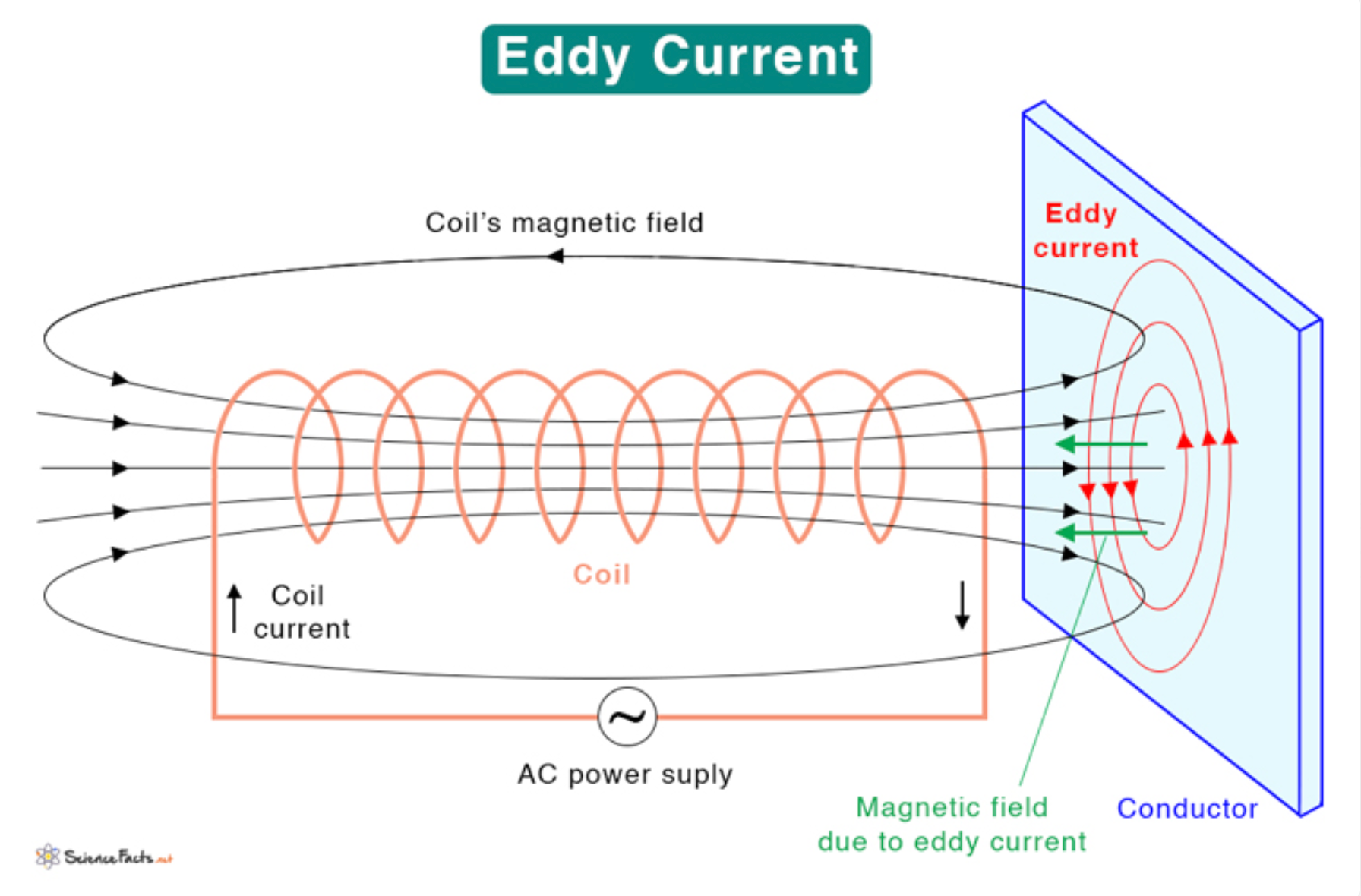
An eddy current is a loop of electrical current inside a conductor when it’s exposed to a changing magnetic field.
(These current loops swirl in a circular pattern – like whirlpools, or eddies in water. Hence the name.)
I know that’s a lot to chew on. And that it’s also really difficult to picture. Just keep it in mind while I explain some of the principles that feed into it. It’ll all make sense in a second.
Principle 1: Current creates a magnetic field
Whenever a current flows through a conducting material, it generates a magnetic field around it. These form invisible concentric circles around the material.

Direct current (DC) creates a steady, static field because current is flowing in one direction. Alternating current (AC) creates a changing magnetic field.
Principle 2: Faraday’s law
If we build on that, we come to Faraday’s law, which states that when a conductor experiences a changing magnetic field, an electromotive force (EMF), i.e. a voltage, is generated. This induced EMF/voltage drives electrons to circulate within the material – in other words, it produces a current.
So, for example, if we bring a magnet – with its magnetic field – towards a loop of wire, an EMF (and thus current) is induced in the wire, as shown in diagram (a) below (from All About Circuits).

Image source: An excellent article from All About Circuits
The faster the change, the bigger the voltage. So if you whip the magnet through really quickly, you’ll get a higher reading on the voltmeter than if you were to do it slowly. And if you leave it stationary (i.e., a static field), there’s no voltage.
The induced current then produces its own magnetic field (because all currents do, as per Principle 1). And the direction, as you can see in diagram (b), opposes the original flux change. This is because of our next principle.
Principle 3: Lenz’s Law
Lenz’s Law states that an induced electric current always flows in the direction that opposes the change that induced it.
More specifically, the induced current creates its own magnetic field that, too, pushes back against whatever flux change triggered it in the first place. It wants to keep things as they are.
So, if we look at the diagram above, the magnet goes from left to right (increasing flux), the induced magnetic field must oppose it (going from right to left) – as seen in (b).
The wire/conductor never succeeds in stopping the change, but it always resists. A bit like the electromagnetic version of inertia.
Back to eddy currents
In a wire, an induced current has one path to follow. But in a solid block of conducting metal (e.g. a copper plate, an iron core or a steel rail), there’s no single wire path. So what happens now?
Well, the same thing. Just now, there are circulating currents in the body. These spread throughout the entire thing, and form closed, swirling loops of current.
These loops are eddy currents.

Image courtesy of ScienceFacts
What changes the strength of an eddy current?
Three main things govern eddy current strength:
- How fast the field changes
- How conductive the material is
- The geometry of the conductor
The speed of change is the biggest lever – refer back to Faraday’s law. If you slowly wave a magnet near a conductor, you get a weak voltage. If you wave it frantically like my (slightly) cringey aunt waves hello, you get a much stronger voltage.
Conductivity determines how easily current flows once the voltage is applied. Copper and aluminium – abundant, cheap and highly conductive – produce the strongest eddy currents (why our crisp-hustling pub trick earlier works so well). Iron is less conductive but has high magnetic permeability meaning it amplifies the magnetic field passing through it. This stronger internal flux can drive significant eddy currents. Insulators, however, produce essentially nothing.
Geometry sets the size of the eddy loops. Large loops enclose more flux, drive more current, and waste more energy. But at high frequencies, a further effect kicks in: the skin effect. This is where eddy currents near the surface of a conductor shield the interior from the changing field, confining all the action to a thin surface layer.
The skin depth (i.e. the thickness of this protective layer) shrinks as the frequency rises. So higher frequency = faster field changes = stronger surface currents = better shielding of interior.
For context, at the UK mains frequency (~50Hz), copper’s skin depth is about 9mm. At 1MHz, it’s 65 micrometres. At 1 GHz, around 2 micrometres – thinner than paper!
With this in mind, then, how does the world use eddy currents?
Wanted uses of eddy currents
It’s not all magic tricks, crisp hustling and magnets in copper tubes. Eddy currents have practical uses. Some very much so. For example…
Magnetic braking
Roller coasters and high-speed trains use eddy current brakes. They have a conducting fin or disc that passes through a magnetic field, inducing currents that push back against the motion (see: Lenz’s law). And you guessed it, that means no contact, wear or heat build-up.
The best bit (unless you get travel sick) is that, if you recall, the electromagnetic forces are proportional to the change, meaning the faster you go, the harder the brake bites. But of course, as you slow, the weaker they get, so they’re often paired with conventional friction brakes to pull them to a stop.
Induction cooking
There’s also induction cooking. Beneath the glass surface of an induction hob sits a copper coil running at 20-50 kHz. The rapidly oscillating field passes straight through the non-conducting glass and into the base of whatever you’ve put on top. There, eddy currents circulate and heat the pan from within, bringing your cold custard to a boil. And compared to gas cooking, it’s also more efficient (85-90% instead of ~70%)!
Maglev trains
Maglev trains also use eddy currents to generate lift. As the train accelerates, superconducting magnets on board induce eddy currents in conducting coils or sheets along the guideway. Those currents create repulsive magnetic forces that push the train upwards. The faster the train moves, the stronger the lift – until it reaches a happy equilibrium where upward forces balance the train’s weight, effectively allowing it to float!

Maybe that’s a bit too much
Non-destructive testing (NDT)
Non-destructive testing is an important use of eddy currents. It allows engineers to check the safety of something without ripping it to shreds and checking. A probe containing an AC coil is scanned across a metal surface. The coil induces eddy currents in the surface layer; those currents generate a secondary magnetic field that the probe monitors. Where there’s a crack or a void, the current paths are disrupted and the secondary field changes, revealing the defect without cutting anything open. It’s pretty common in aerospace (e.g. fuselage panels, turbine blades, fastener holes).
Coin sorting
And maybe the coolest one last: coin sorting. Coin validators in vending machines use eddy current signatures to identify alloy composition. Different metals produce different phase responses, so a genuine coin and a slug of metal of the same weight (but with different conductivity) register differently.
Recycling plants take this further, spinning a drum of permanent magnets induces eddy currents in non-ferrous metals on a conveyor belt, generating a repulsive force that flings aluminium cans sideways while plastic and glass continue ahead.
Unwanted uses of eddy currents
We’ve seen some good bits, but let’s be real here… nothing is without its pains. Even custard…
In electrical machines (like transformers, motors, or generators), heat is the enemy. The same alternating magnetic field that does lots of useful work also induces eddy currents – and a lot of heat. In a modern, well-engineered mains transformer, for example, core losses run at 0.1-1% of rated power. At higher frequencies, however, they can reach 10-50% of input power if left unmanaged.
So how do you overcome this?
The classic solution is lamination: slice the core into thin sheets of silicon steel, insulate each sheet from the next with a thin oxide or varnish layer, and stack them up.
Eddy currents must flow within each lamination – they can’t cross the insulating gaps – so the maximum loop size is limited to one’s sheet thickness.
Above roughly 10-20kHz, even thin laminations can’t keep up. The skin depth becomes smaller than the lamination thickness, and the field can’t properly penetrate the core (which we want to happen to distribute flux), and losses balloon.
So, now, the solution becomes ferrite: ceramic compounds of iron oxide, which are excellent magnetic materials but almost perfect electrical insulators. Their resistivity – a million times higher than silicon steel – means eddy currents are essentially zero, regardless of frequency.
Every switched-mode power supply, wireless charger and phone contains a ferrite core for exactly this reason!
Closing the loop
There we are. Now you’ve met Eddy and his currants. Currents*, sorry.
Understanding eddy currents means understanding something fundamental about metal – how it responds to change, how its conductivity and geometry determine its behaviour, and the material something is made from matters as much as its shape.
And that makes a perfect segue into material personalities. Personalities we love to explore and turn into joyous tools and fidgets.
If you’d like to explore some of our new personalities for yourself, you can do so here.

Like this spinning bundle of fun - Helico Mk3
I hope you’ve enjoyed reading. If you have, head over to our subreddit or Cube Club to get lots of inside knowledge of what’s happening here at MetMo.
See you in the next one!



Share:
17+ Father’s Day gift ideas for 5 types of dads in 2026