

You’re 15 miles from home. Your back tyre is flat. You’ve got your phone, your keys and a half-eaten energy bar. What you gonna do – call Ghostbusters? I hate to inform you, but the only ghost they’ll be saving you from is the ghost of bad decisions… Because if this story sounds familiar, you’ve probably realised you needed some tools when you don’t have them.
Uh-errrr. *My buzzer noise*
Actually, there’s a saying that comes to mind. Something about being up a creek without a paddle? Anyway…
Cyclists need tools. Tools are your paddle. And they’re the very things you need to get you out of this regretful, deflated mess. So today, I’d like to talk to you about said tools – EDC tools, in fact – and share 5 of the best ones a cyclist might consider carrying.
What is EDC, and why should cyclists care?
EDC stands for Every Day Carry. In the broader, not just two-wheeled world, it’s a philosophy of carrying a small, deliberate set of tools that handle the most likely problems you’ll face. It’s a thing for tradesmen, one-bag travellers, business folk and of course, the avid cyclist.
So, these are the tools that live on you on every ride. Not some behemoth toolbox from your shed. Nor a trailer stuffed with every contingency. I’m talking about the rock-solid essentials – the light, compact, and genuinely useful bits of kit that you can carry to get you up the proverbial creek.
Because potholes will come. You must prepare.

You never know when you might need to dig yourself a hole, am I right?
What makes a good cycling EDC tool?
Before we get into the list, it’s worth setting a bit of a criteria. Based on Redditors’ experience, a good cycling EDC tool is light enough you forget it's there, but capable enough that you’re glad it is.
It earns its place by solving more than one problem, or by solving one problem so reliably that it's a non-negotiable. And, maybe understatedly, something you can work on the side of a road in Stoke on a cold, wet and windy Tuesday night.
Let’s dig in.
The best 5 EDC tools for cyclists
Multi-tool
Arguably the most important. If you only carry one thing, lots of cyclists say it should be this. A good cycling multi-tool covers the vast majority of roadside fixes: loose bolts, saddle adjustments, stem issues, cleat problems, brake levers, gear indexing… The list goes on.
Most mid-ride mechanics are nothing more than something that’s worked itself loose.
The key, though, is getting a multi-tool that’s actually built for bikes. Y’know to maximise your bang for buck. That means hex keys that fit your components properly, a chain breaker, and – ideally – a mini ratchet drive. The Crankbrothers M19, Park Tool IB-3 and OneUp EDC Tool are all solid choices.
Mini-pump
There are two groups of people here: CO2 supporters or manual pumps fanatics. CO2 cartridges are fast, small and genuinely useful, especially for seating tubeless tyres mid-ride, which a mini pump usually can’t do. But they have one fatal flaw: when they’re gone, they’re gone.
A mini-pump, however, never runs out. It works on the second flat, and if you’re so unlucky, the third. It can help a fellow rider who’s stuck. It doesn’t create single-use waste either – something we like here. For all but the most race-focused riders, it’s the more practical (and cost-effective) choice.
The OneUp 100cc Pump is a favourite for MTB riders because of its size. The Topeak Road Morph G has a fold-out foot peg and a pressure gauge, which makes a real difference when you’re picky on your PSI. The Zefal Frame Pump is also a classic for a reason.
Chain tool + quick links
A flat tyre is a real pain in the seat. But a broken chain ends your ride full-stop. A chain tool and quick links go together nicely because they solve the same problem from different angles.
A chain breaker – usually built into your multi-tool – lets you remove damaged links. A quick link gets you back together fast without too much faff. SRAM Power Links and generic quick links both work well. Most experienced riders carry two links.
There’s also a lot of debate online about reusing quick links. Manufacturers say don’t. Plenty of riders do, repeatedly, without incident. The practical consensus is as long as it clicks firmly into place and takes real force, it’s fine.
Chain failures are the second most common ride-ending failure after punctures. Carrying a chain tool and a couple quick links weighs almost nothing. And not carrying them could weigh heavier… when you’re carrying your bike home…
Tyre levers
Bike tyre levers are a bit like me on a Friday evening, unglamorous (and a bit dishevelled). They’re also cheap… and absolutely essential.
Unless you’ve got the grip strength of Brian Shaw, you’ll probably never get that tyre off the rim. Try it. You’ll spend 45 mins fighting the tyre, probably pinch the new tube in the process and bruise your fingertips heck knows how many times.
Good tyre levers just make life so much easier. Bad ones snap when you don't want them to. So it’s worth getting a good set. Pedro’s and Park Tool (the TL-6.2 second hand, or now, 6.3 in particular) are the two names that come up most in communities. They’re inexpensive, practically weightless, and the kind of thing you’ll be pleased to tuck away.
Patch kit or tubeless repair kit
Which one you carry depends on how your bike is set up. Running inner tubes? A patch kit is your backup when the spare tube is already in use. A decent kit – Rema Tip Top is recommended highly – takes up almost no space and gives you multiple repairs from a single pouch.
Running tubeless? Carry a plug kit instead. Dynaplugs are the name that comes up constantly and for good reason – a plug takes seconds to insert, often without even stopping to pump the tyre back up. You’ll still want a spare inner tube as a last resort for damage that plugs can’t handle. It might not be the most optimal setup, but should still get you home.
How to carry it all
Five tools sounds like a lot until you lay them out. A compact saddle bag handles everything here – multi-tool, levers, patch kit, quick links, and there's usually a spot for a spare tube too. The pump clips to your frame or tucks into a jersey pocket depending on the size.
If you’re a jersey-pocket rider, the multi-tool and patch kit go in the back pocket, levers clip to the pump or live loose, and quick links take up almost no space wherever they are. So, total weight is negligible, and the inconvenience of carrying it is not much more either.
The challenge (and discipline) isn’t packing it per se but making sure it routinely comes with you. Because mum knows when you don’t, you’ll need it.
Two more worth knowing about
The five EDC cycling tools above cover the essentials. But two tools, not including a first aid kit, repeatedly come up in EDC conversations, so they deserve a special mention, especially if you ride long distances, commute or just like being genuinely prepared.
Pliers
Specifically needle-nose. Pulling glass or thorns from the tyre before they work deeper, managing cables, even occasionally helping you open master links. These are fiddly jobs that fingers – especially mine – cannot do. A multi-tool integrated pliers (e.g. Leatherman style setup) covers this without adding a separate item. Some riders swear by Knipex Pliers Wrench for the way it grips awkward shapes and can replace multiple spanners in one go.
A small wrench
Most modern bikes are hex-key territory, but cranks, pedals and older components often need an 8mm, 10mm, or 15mm. An adjustable wrench covers the bases without committing to specific sizes.
These aren’t on every rider's back, but they solve problems that everything else can’t.
MetMo’s cycling-suitable EDC tools
And those two tools are two reasons why we made the following two tools. They’re multi-use and perfect for cycling EDC.
Pocket Grip
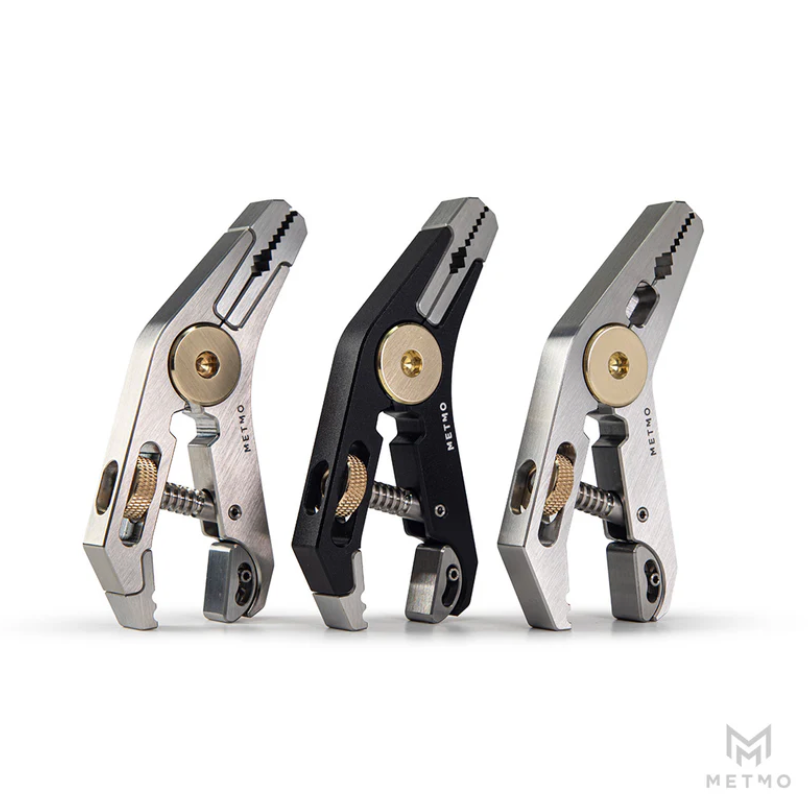
The Pocket Grip combines a parallel wrench, pliers, hex driver, tap and clamp into one pocket-sized tool.

The adaptive jaws also grip awkward shapes and non-standard nuts that standard tools slide off. It’s the pliers-and-wrench combination in a single item, designed to go everywhere without noticing it's there.
See the Pocket Grip collection, and how it works, here.

Pocket Driver
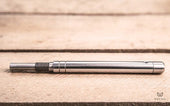
Similarly, the Pocket Driver also covers a lot of jobs in one. Rather a lot of tools in one. It handles the hex and driver side – allen keys, screwdriver bits, T-driver functionality with inline storage for two emergency bits built right in.

It also has more torque than my mouth after 2 coffees in the morning. If your multi-tool covers the basics and you want something that handles precision work properly, this is it – in my very humble opinion, at least.

See the Pocket Driver collection here.
The final spoke
EDC doesn’t require you to be prepared for everything. Even with what I’ve got in my rammo-jammo garage, you could still argue (I do because it helps me buy more tools) that I’m not prepared for everything. But as a tight-knit selection of tools that help you confront regular challenges, I think these are great for the overwhelming majority of them.
So build the kit, pack the kit and keep the darn kit together!
What’s in your cycling EDC? Let us know in our subreddit or CubeClub - we’d love to know.
See you in the next one.
Oh, and if you want to see what else we’ve recently made, you can here.
Share:
Eddy currents explained: The story of Eddy and his custard-like antics